After deciding to become a digital nomad, I had to figure out what would become my new home. There are quite a few options, and I started looking into every one of them.
If you’re considering the digital nomad life, this blog is an excellent resource to help you brainstorm potential digital nomad homes. There’s also a fun quiz at the bottom that anyone can take to see what their ideal digital nomad home is.
The Options
The first thing I considered was, of course, the ever-so-romanticized van life.

Then, I started looking at campers and RVs. Initially, I looked into pulling a super lightweight travel trailer with my Subaru. I briefly contemplated a tent option and then turned my attention to campers with larger layouts and trucks that could pull them.


I also checked out Airbnb options along my planned route. And stumbled across communal living spaces for digital nomads.


As I started to go through all the options, I began to organically create a list of things I wanted and didn’t want in my nomad home.
- A full shower
- Running water
- A flushable toilet
- Reliable power
- Safety from the elements
- A bed that didn’t require to be taken up / down every morning and night to have a table
- An office space that didn’t double as my table
- A sleeping spot for Trixie (she was never one to sleep in bed with me)
It was important to me that my choice be comfortable and convenient. If I was miserable every day or distracted just trying to survive, the digital nomad life would not be sustainable.
With my list in mind, I started analyzing the options and deciding what was best for me. Along with my must-haves – budget, space, ease of travel, and location and weather also impacted my final decision.
Budget
Budget – I wish they could all be unlimited, but unfortunately, it’s a big thing to consider.
I get asked a lot if I’m saving money doing this. I’m not. It was never the goal. I repurposed my monthly rent + utilities budget to a truck and camper payment + the cost of RV parks and gas.
Luckily, all the options have ways to make the digital nomad home affordable. Buying used, staying on free Bureau of Land Management (BLM) land, crashing with friends, & renting a room vs. an entire house can stretch the budget.
RVLife vs. VanLife vs. CamperLife
There are three major categories of campers. Class A, Class C, and travel trailers. All will range in price based on age, condition, and mileage, just like a regular car or truck would.
New Class A RVs, the long, driveable, bus-looking ones, will typically be well over $120k. Used ones, a few years old, are typically $60-$80k. The Class A never really intrigued me much. They were massive and expensive. I would only want to drive it around if I towed a car behind me. The Forester wasn’t capable of being a ‘toad’ as they call them. I would have been worried about buying used and any mechanical issues. Other than for ‘funsies’, I never toured them too seriously.


Class C RVs, the ones that look more like a truck, are around the $100k mark for new. Used ones, a couple of years old, are around $60k-$90k, depending on size and how good of shape they are in. But, for much of the same reasons as the Class A, having to tow a car, and being worried about mechanical issues, I didn’t like the idea of these either.

Van life was intriguing, but the cost of a new build was a serious cause for sticker shock. They are over $100k. You can find older, used ones on the market for considerably cheaper. I did love the idea of buying an old one and completely remaking it. But, as easy as all the Insta videos make it look, I knew I didn’t have the right knowledge, tools, time, or mechanical ability to do this. Many places will customize them for you as well, but they also cost a pretty penny.


Travel trailers or campers, whatever term you like better, seemed more of a possibility. You just hooked them up and towed them behind you. A fairly daunting task for someone who has never towed. They range in price and size and come in every imaginable layout you can think of. The price is pretty decent on them too, ranging from $10k for smaller brand-new ones to $60k plus for the longer, fancier ones.
If you look at the used market, you can find them at even more affordable prices.

Budgeting for RV Parks
The other major thing to budget for when considering camper or van life is where you will park them.
RV Parks with full hookups, meaning water, electricity, and a dump station for gray and black water, easily the most worry-free way to stay, typically cost more than a site without. I’ve had them run anywhere from $30 – $100+ a night, depending on the location and time of year. Longer stays, 30 days or more, are usually discounted.
This is the trickiest thing to budget for because it’s variable. I know the price range I want to keep the daily rate under. If I go over at one site, I can make up for that at another site.


RV Park Alternatives
Harvest Hosts and Hipcamp have also been 2 of my favorite apps when I’m looking to save on stays.
Harvest Hosts is a yearly subscription for $100. It gives you access to thousands of businesses, wineries, breweries, golf courses, and other attractions that will let you crash in their parking lots. For a little extra cost, it gives you access to Boondockers Welcome. A network of homeowners that will allow you to stay outside their houses. The only cost is the annual subscription. I mainly use Harvest Host for travel days when I need a quick spot to rest. However, I have gotten lucky and found some hosts with full hookups that allow you to stay the full three days.
Hipcamp is similar. However, it’s mainly people’s yards and lands. It’s free to sign up. The grounds listed have a nightly rate. However, I’ve found that Hipcamps spots tend to be less than RV parks. They sometimes lack a dumping station, but I have found plenty of sites with water and electricity. If I’m only staying for a couple of nights, I don’t necessarily need a place to dump. It’s easy enough to find a location along my route and dump my gray and black water. My friend and I stayed at Hipcamp in Montana and paid half of what we would have for an RV park.
BLM Land, (Bureau of Land Management) also offers free places to stay. The catch, it’s first come, first serve. They also don’t have any type of hookups. I did this one time. It was dark by the time got there, the site was packed, and I had trouble backing out to leave. Thankfully, someone offered to move their car, opening a spot where I could stay. I haven’t done it since, but it’s still a good option for those looking to save money.


Don’t forget gas!
Lastly, remember to budget for gas! This will vary depending on how often you plan to travel and how far. It adds up quickly. I get around 10 MPG when towing. I moved every 1 – 2 weeks on average for the first couple of months and was spending $500+ a month on gas.
Airbnb and Digital Nomad Spaces
Airbnbs are typically $60+. It was here that I ruled out this option. In trying to stay under a $2,000 monthly budget based on my current rent, I could only go up to $66 a night. I scoped out Airbnbs around a few places I wanted to visit, but even with discounted rates for monthly stays, still blew the budget. The places that would have been reasonable were often just a single room for rent. Which didn’t sound appealing to me.
I looked at some spaces designed for the flexibility of digital nomads: fully furnished, short-term leases, strong wifi, etc. They were about the same as or more than what I was paying in rent.
Space
This is a big one. There were two things I knew I wanted. A sleeping area just for Trixie and office space. I did not want to be hunched over a table working from my laptop. Nor did I want monitors taking up my only table space.

I recommend touring the different options and getting a feel for them. Videos and pictures alone can be misleading. I also looked at hundreds of floor plans for campers and vans, trying to decide what would work best.
Campers and vans are typically made for vacations that last a week or two. It’s easier to compromise on an inconvenience when it’s only temporary. But when you’re going to be spending every day in one of these, it pays to consider which inconveniences will become too much. Think about your day-to-day routine. How would you need to adapt to a smaller space? What would the reality be like to live there? How would you make your coffee in the morning, do yoga, and get ready? What are you not willing to give up, and what are you willing to compromise on?
As I was researching everything, the search algorithm Gods started sending me articles and videos on the realities of van life vs. Instagram. I’d suggest checking out some of these as well and seeing what you may be in for.
More things to consider
How many people are you traveling with? Is it important to have your own space? Are you going to be cooking often? Do you need counter space or a large pantry? Extra storage for dishes and gadgets? Are you okay with folding a bed or table daily to make space? Will you mainly use it as sleeping quarters, or do you plan to spend a lot of time inside? Do you need office space, monitors, or external keyboards? Do you have hobbies that will take up space? What amenities of your home are most important to you now?
Think about outdoor storage as well. Do you have a lot of toys, kayaks, paddleboards, or bikes, that you need to haul around? You’ll inevitably have tools and rugs and chairs you’ll need to carry around too.
And lastly, headspace. I’m 5’3″, so I almost forgot about this, but I hear it’s important to tall people.
Bathroom needs
Going hand in hand with the question of space is what you need in a bathroom. An uncomfortable topic maybe, but with it being such a basic necessity, absolutely necessary to give extra thought to. Are you comfortable doing #2 in a toilet bowl under your table? Asking your partner to leave every time? Are you comfortable changing compost bags? Are you okay with walking to camp bathrooms and showers?
I toured campers with toilets that folded underneath the table. That was a hard no for me. I definitely wanted a separate bathroom space. Teeny tiny camper life was crossed off the list.
Showering is essential, too. At least to me. Do you need a long hot shower every day? Are you okay with cold showers or outdoor showers? Do you want a full-size shower? Would a wet bath be okay? As someone who recently spent three weeks showering in an outdoor tent with crickets, I definitely prefer to be connected to city water and be able to take a nice warm shower.


Weather & Location
I knew I would be sticking to exploring the United States. International travel with a dog would be challenging. It requires a different set of planning that I’ve only just begun to contemplate.
I had no plans and still have no plans to do any type of ‘winter camping’. However, even in the Spring, 70-degree days drop to below 30 nights quickly. It was one of the reasons I ruled out tent life early on. I like to be warm and cozy.
Lessons Learned On Cold Weather
During the first two months of my trip, I found myself in below-freezing temperatures at night. It took me running out of propane twice to learn my lesson on making sure I was always stocked up. Luckily, with the help of a heated blanket, I stayed pretty warm. There was also the morning I woke up in West Texas to my water and dump pipe froze shut. Luckily, the sun thawed it out quickly, and there was no damage.


If you are planning on winter camping, it’s best to ensure your rig is suited for it. If it is below freezing for over 24 hours, you need to protect your pipes from bursting. I’ll be in the PNW through the end of the year and am currently exploring my options for keeping my pipes from freezing. Maybe I’ll get lucky, and we’ll have a mild first half of the year, but it’s better to be prepared.
Don’t forget about the heat
On the opposite end of the spectrum, campers and vans heat up FAST in the sun. Not all options have an air conditioner, which can make for miserable days and nights. Imagine sleeping in a van on a hot night. Even with the windows open, there’s little airflow. It’s the same with a camper. Generators can be used to run AC when electricity isn’t an option. However, they are noisy and some campgrounds have rules against them at night. I also have a Renogy portable power station that can be solar-powered. I have to look more into this. It can charge the camper battery, but I’m unsure if it’s got enough juice for AC. Plus, without the sun at night, the batteries will drain fast.
Ease of adventure
This played an enormous role in deciding to go with camper life. I wanted to be able to ‘just go.’ With a camper, I can unhook, have my truck free, run to the store when needed, go on adventures, and not worry about carrying my home around with me. With vans and Class Cs, I considered having a bike or moped with me, but at the end of the day, I still needed something Trixie could ride along in, too.
I kept picturing myself with a van, awning out, rug out, chairs out, set up nice, and then realizing I needed toilet paper and having to take it all down. It’s more than just the outdoor setup. Inside, everything set out on a counter must be put up before taking off.
I left a bottle of mouthwash on the bathroom counter one trip and got hit in the face with the minty scent when I opened the door after towing. It had fallen, spilled everywhere, and freshened up the inside of my camper.
Not to mention, every cupboard door is like a jack in the box when you first open it after a trip. You never know if things will shift and what will topple out at you.
Would van life be easier?
On the other hand, the most tempting thing about a van was its ease of being able to ‘just go.’ Towing can be a pain. You have to consider every turn, every gas station, every road so as not to get into a pickle. Plus, there is the nightmare of having to back it in to sites. With a van, I feel like it would be simpler to pull in somewhere for the night. There’s not as much concern about getting yourself into a jam.


The counter for this is that I didn’t really want to be sleeping in parking lots or places without power or running water all the time. There are solar and generator options, but being a first-timer, I wasn’t ready to tackle being off-grid often. I wanted a more convenient option while I learned the ins and outs of digital nomad life.
The Airbnb option was also very tempting for this reason. There would be no need to purchase anything, to tow anything. I could continue to basically rent in whatever city I felt like. The downside is that when moving a lot, you constantly have to haul things in and out and set up your workstation. Plus, with a van or camper/truck, at the end of the day, you’ll own something, too.
The Final Decision
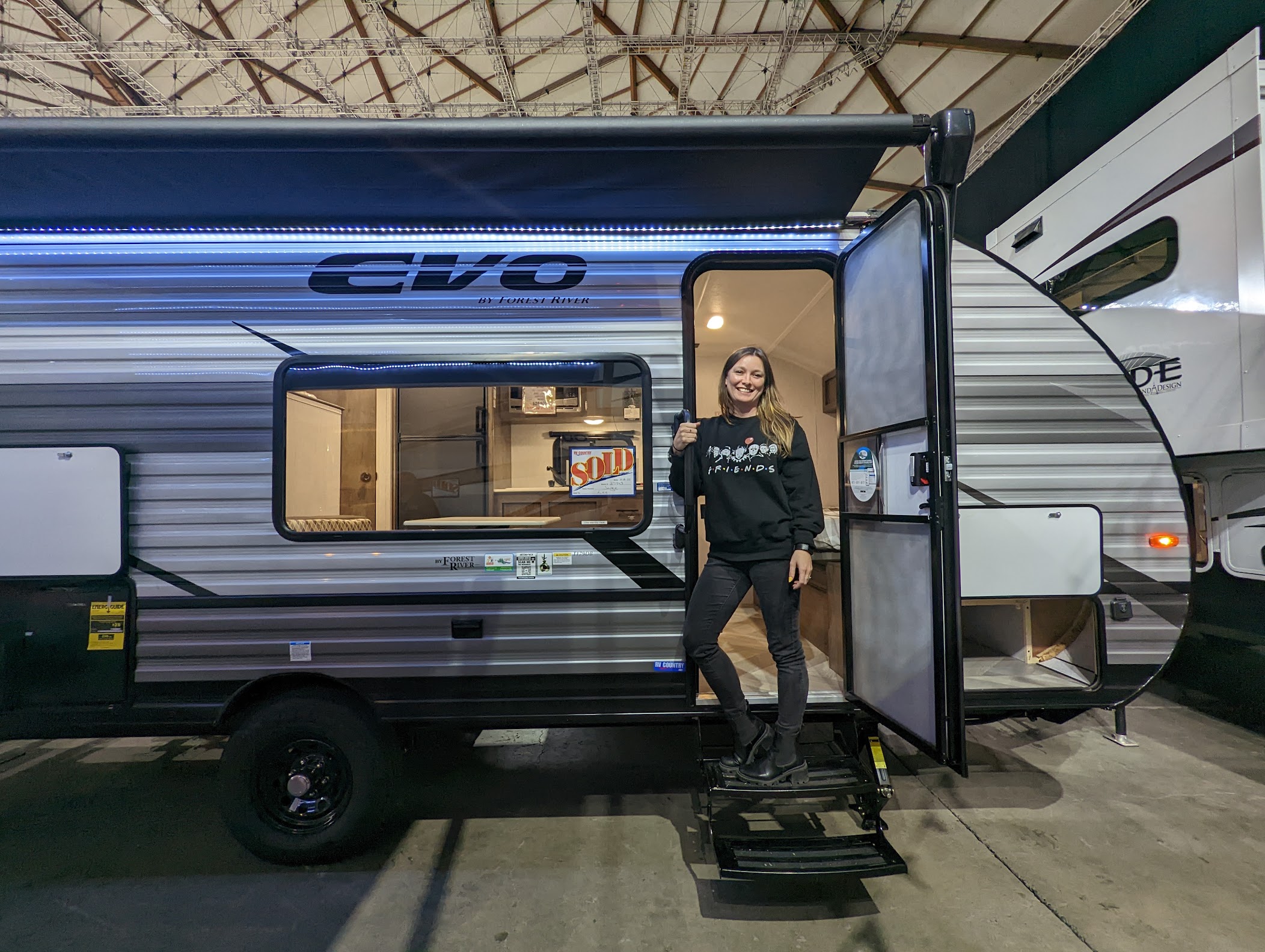
I ultimately settled on a little 23-foot, tip-to-tail Forest River Evo travel trailer. I bought a brand new one and opted for the warranty. Altogether, it ended up costing about $30k. It checked the box on everything I needed. A bed that didn’t have to be set up every day, space for an office & Trixie (once the bunks were torn out), a decent-sized bathroom, and a small kitchen with a table.

I decided on brand-new everything because, as a female traveling solo and first-time trailer owner, I wanted reliability. I also knew nothing about camper life and wanted assurance that if something went wrong, I had a support system and place to bring it.


I toured some larger campers and was extremely tempted. Still, I went with this little guy. The interior space is about 17 feet long and 7.5 feet wide. For me, the purpose of becoming a digital nomad was to explore. The small, tight space doubles as motivation to get out.
Check out my Instagram to see a 50-second tour of my little camper.


Picking out a truck
I actually bought the camper before the truck. The camper weighs in at 3,342 pounds and gave me an idea of the size truck I would need. Being a Toyota owner my whole life, aside from the Subaru (which I won – different story), I knew I would likely get a Tacoma or Tundra to pull him with.
As I started to look for trucks, the advice from the dealership was to go bigger. A Tacoma could pull it, but I would feel it more. The Tundra would have no issues, get better gas mileage, and put less wear on the truck. There wasn’t much for inventory except in silver. I was a little bummed. I know color isn’t that important, but I wasn’t crazy about having a silver truck. When the dealership called an hour later, saying they had 2 Lunar Rock-colored Tundras on the way, I immediately put money down to hold one. I picked up this beauty a couple of days later.


Some of the vans I toured were impressive, but ultimately, I couldn’t find one, within the price I wanted, that had separate office space + a space just for Trixie. I was also adamant about not having a bed I would have to put up every day to have a table. Besides that, I love the freedom a truck allows me.
Change of heart?
After having lived in my little camper for a few months, I’ve toured some larger campers that still give me envy. Being more comfortable with towing, I’ve thought about trading up. In the end, it comes down to the same thing it always has. I don’t want a large camper that will tempt me to just hang out in it. In the times I have to be in it, it’s cozy and comfortable and has everything I need. But I go stir-crazy if I’m in it for too long, and it forces me to get out. Plus, I’m sentimental. It’s my first home as a digital nomad, and I’m not ready to give him up yet.
I was also entertaining changing my setup after Trixie passed. I started pondering van life or a Class C. But my mind still kept wandering back to why I chose camper life in the first place. As fun as van life looks – I still cringe thinking about having to drive it everywhere, all the time. I see the temptation behind it, the freedom, but it’s not right for me yet.
Besides, have you seen my truck? It’s freaking gorgeous. As soon as I said the words out loud that I was thinking about getting rid of her, I realized, “Nope, don’t want to do that”.

And so, camper life it is for me.
For now.


